Hiring the Right Keynote Speaker

When hiring a keynote speaker, factors such as the event date, location, and your budget will play an important role in determining the pool of keynote speakers available to you.

Date, location, and budget

Your date, for example, will affect which keynote speakers are available, whereas your budget will limit who you can and can’t afford to hire. In order to save on the cost of the keynote speaker’s travel, you may want to consider the distance between where he or she resides and where your event will take place.

Sync up the type and time of the keynote

Determine the type of presentation you want and the time of day it will take place. Some speakers are skilled at delivering workshops, while others excel at providing keynotes. After-dinner speakers should incorporate humor into their talks, where morning speakers should be energizing.

Clarify why you want to hire a keynote speaker

Some common reasons include the desire to educate, motivate, shift behavior, and initiate a change, and entertain. Consider which keynote speakers have been successful in the past with your group or a group similar to yours.

Get references

Call your friends and associates. Asking for references can be a great way to narrow down your search. Establish who the core decision makers are regarding a keynote speaker and tap into their vision.

Consider the demographics of your audience

Do you need a keynote speaker who will appeal to a general audience or one who will interest a specific demographic group?

Consider all of these factors and reach out to the Keynote Speaker Experts, we’ll help you hire the perfect keynote speaker for your event

The Importance of a Keynote Speaker at a Corporate Event

Event and meeting planners are faced with numerous difficult decisions but the choice to book a keynote speaker is not be one of them. Keynote speakers are an event staple.

Whether it’s a celebrity speaker or a popular business speaker, a good keynote speaker will provide relevant content that engages and educates audience members and provides them with an experience unique to your function. Here’s why you should consider one for your next event:

Increased event hype and registration numbers

Good keynote speakers, especially popular public figures, can bring their own audience to an event. And it doesn’t take a genius to figure out that higher registration numbers mean higher revenue.

Increased event credibility and recognition

Picking a keynote speaker with relevant expertise can make your event seem more important and more worthwhile for guests to attend. Make your event the one to attend this year by booking a great storyteller who can provide insightful information attendees won’t find elsewhere.

Increased attendee engagement

Good keynote speakers with a strong message can captivate an audience, no matter how large. Make sure the content is useful and interesting to guests by asking potential keynote speakers the right questions ahead of the event to determine if they will be a good fit for your demographic.

Although they can be pricey, a keynote speaker can provide a great return on investment, and they will make your event unique and memorable for all in attendance.


What is a Keynote Speaker?

The term keynote speaker often gets thrown around loosely and many people have different ideas about what the word actually refers to. When they hear the word keynote speaker, some people think of a motivational speaker, business  speaker,  industry expert, or a closing speaker. If you’re a business executive or an event planner, what you might actually hear, when you hear the word keynote speaker, is that you need to hire someone who can talk to our audience for about 45 minutes and they will probably cost a lot of money.

In actuality, a keynote speaker could speak on any of the above listed subjects, but what defines a keynote speaker is their ability to capture the essence of your meeting and to highlight it to your audience in a short period of time. In order to capture this essence, the keynote speaker should be willing to spend the time researching your industry, your issues, and your audience.

Once the keynote speaker completes his/her research about your organization, the speaker can then mold the presentation into a unique and distinctive presentation just for your audience. The keynote speaker may incorporate humor, audience participation, or show funny clips to add an extra bit of fun and entertainment to their talk. No matter, what shtick the speaker employs, their job is to weave your keynote message into their program in a fun and memorable way.

This is why choosing the right keynote speaker, who aligns with the message of your organization and the event, is crucial not only to the success of the event but also to how affective and engaging the keynote will be to your audience.

Booking a Keynote Speaker? What You Should Know

Planning on hiring a keynote speaker for a corporate event, conference, or summit? If you’ve never booked a keynote speaker before, or you feel like you could use some event planning hacks, here are some keynote event planning tips to help you plan a stellar keynote event for your organization.

  • Scheduling mistakes

If you’re scheduling a keynote presentation, avoid making it around a meal. Keynotes during breakfast, lunch, or dinner — or right after lunch and dinner– distract the audience from the keynote speaker and their message. And people tend to fall into food comas after finishing their meal.

  • Tech and AV requirements

Don’t insist that a keynote speaker modify their graphics to fit a particular event template for all slides. Keynote speakers’ brands should be respected — that’s part of what you hire them for.

  • Let the keynote speaker do their thing

Don’t demanding to see the keynote speakers’ presentation slides ahead of time (the best speakers are tweaking them on the plane until final touchdown) and please never distribute a keynote speaker’s slides to audiences beforehand. Maintain some suspense! Instead, get your keynote speakers to send a 30 – 60 second video clip beforehand of their speaking at a previous event. This helps with internal and external promotion.

  • Break it up

If it’s a lengthy program, add an emcee or host to help break up the long day and create opportunities for interaction. (Note: this is someone other than the keynote speaker, and can sometimes be pulled from your own organization). Also Build in some breaks. Conferences try to pack too much in, if you add in breaks and the keynote speaker’s message will sink in better and the audience will come back refreshed and ready to hear more of the keynote speaker’s message.  

Pre-Event Planning Tips from Keynote Speakers

You undoubtedly have an event planner checklist that you’ve refined/perfected over the years. Here’s a chance to perhaps refine it further from advice straight from keynote speakers.

PRE-DECISION CALLS BETWEEN THE KEYNOTE SPEAKER AND THE CLIENT

“I think great outcomes begin by selecting the right speaker to meet your needs. Even the best speaker may fall short of expectations if assumptions are being made about their relevance to the topic – or some other issue.  That’s where a pre-decision call can give event planners peace of mind – and allow the speaker to determine if he/she is a good fit. More importantly, a lot of speakers might be able to give you some great ideas on how to maximize their impact and get the most out of your investment. I have given over 1500 speeches and can share ideas of what I have seen work well. I am always happy to talk with event planner before they pick me.  It is reassuring to all concerned.  It’s hard to correct a situation where the wrong speaker was chosen in the first place.  A pre-decision call is a perfect way to assure a successful speech.”

–Mike Abrashoff – Former Navy Captain and Author, It’s Your Ship

AS AN EVENT PLANNER, KNOW WHAT YOUR AUDIENCE WANTS

“I was to keynote the funeral directors symposium for state association directors and their assistant directors.  In my preparation research I learned that, reacting to the bestselling book, The High Cost of Dying, the FTC had issued new regulations on price disclosure that intensely angered most funeral directors.  The association’s executive director, however, assured me that, while some members were still hot over the issue, his state directors were ready to move on and eager to learn how to teach their members ways to effectively communicate with their customers.

“He introduced me and outlined my topic. As I was about to speak, one audience member walked to the floor mike and said, “If that is your topic, I have wasted my time coming to this meeting.”  The entire audience broke out in applause.  I had not yet spoken a word.  I quickly huddled with the executive director, now totally embarrassed by the reaction of his state directors.  As I had warned him, they were far from over their anger over the regs.

“After agreement on a change of plans, I announced to the audience I was relinquishing my time to the association attorney to talk about the FTC regulations. I got a standing ovation…and took an early flight home, but I felt bad for the executive director who had to deal with the consequences of his failure to understand the real needs of his audience.”

– Chip Bell – Customer Experience Expert and Author, Take Their Breath Away

DOES ANYONE KNOW IF THE KEYNOTE SPEAKER IS USING POWERPOINT?

“I can’t count how many times I send a technical rider (which is very easy) in advance and the things that I’ve requested aren’t there.  I can easily get by without any of it, but the things that I (or any speaker) requests are there so that they can give the best presentation possible.  Help your speaker do the best job possible for your audience and assign someone the responsibility to make sure the tech needs are passed on to the right person and in place at the event.”

– Bill Herz – Master Magician


Choosing the Right Event Venue– Advice from Keynote Speakers

Add this thought to you event planner checklist: Does your event space help the keynote speaker to succeed?

The purpose of this article is to provide valuable tips for your event planner checklist. When it comes to booking event keynote speakers, almost nothing is as important to your ROI than the event space. Any event planner checklist should include a few key elements relating to the room and how well it enhances or interferes with the presentations of the keynotes speakers you’ve hired.

Here is some advice straight from the keynotes speakers themselves to consider before booking Your next event venue.

Avoid the outdoors

“Probably the worst was a talk I gave on one of those dinner cruise ships. This was a fairly small group, maybe 30 or 40, and the ship’s dining room was barely big enough to hold them. When I checked it out before the cruise departed, the air conditioning was so loud that I knew I couldn’t be heard — there was no sound system — so I asked that they shut off the AC when I started my talk. When the time actually came, however, the ship was underway and the engines were MUCH louder than the air conditioning.  When the staff obediently shut off the AC at the beginning of my talk, it didn’t make a bit of difference to the noise level, but it did cause the crowded dining room to become very hot. I tried to yell my remarks over the sound of the engines, but I doubt if more than half the audience could hear anything. Perhaps the one saving grace was that by that time pretty much everybody, except me, was drunk.”

– Geoff Colvin, Fortune magazine, Author, Talent is Overrated

Odd sized rooms need extra sound reinforcement to compensate

“One time I was invited to speak and receive an award from a university during a reunion. The room was laid out in the shape of a long skinny rectangle, and the acoustics were terrible — so the only people who could hear me were the people at the top of the rectangle. The rest, I imagine, carried on happily reuniting with their former classmates — what else could they have done?”

– Susan Cain, Author, Quiet: The Power of Introverts in a World That Can’t Stop Talking

Fear the big room half-full

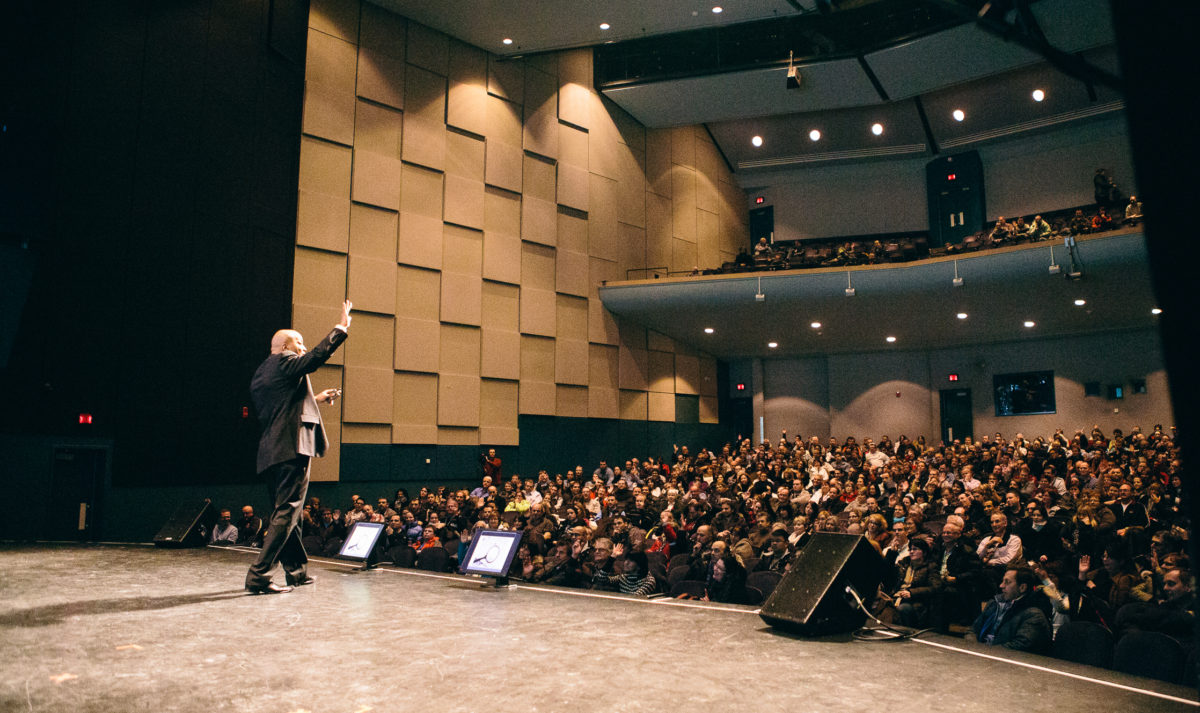
“1,000 people can generate great energy, unless they’re spread out in an NFL football stadium or an arena. I had that experience once. The stage was on the 50-yard line – mid-field and a LONG way from the audience. A great sound system was in place but it was a strange vibe overall in an otherwise empty stadium.

“If you want to meet somewhere like that, fine; give people a tour but then cluster them in a place that can sort of make sense, like behind where the team would sit during the game, and have the speaker up close, not far away and high in the sky.  Whenever the room is much bigger than the size of the crowd, rope off the seating area and have the ushers send people forward. It enhances the crowd energy tremendously and makes for a much more successful audience experience.”

–Tom Morris, Noted Philosopher and author, If Aristotle Ran General Motors

Event planner checklist priority: eliminate “the gulf”

“Ask comedians, entertainers, and motivational speakers about the biggest challenge to connecting with an audience and they’ll tell you it’s “the gulf” – the distance from the front of the stage to the first row of seats. The greater the distance, the harder it is to connect, and the lower the energy. It’s no different with speakers. Many of the stories here make that point. Whenever possible, have your audience seated as close to the action as possible. The energy will start up front and ripple through the room. It can literally change the outcome of the presentations and should be a critical goal on any event planner checklist.”

– Tony D’Amelio, Principal, D’Amelio Network