
10 Common Themes in Healthcare Leaders’ Strategies

As seen on BigSpeak.com

What’s going on in healthcare? How will changes in technology, law, and demographics change the type of care hospitals give—for the better or the worse? Healthcare keynote speaker and top healthcare futurist, Ian Morrison, has the answers. He examined the current climate of the industry and found 10 healthcare trends that will be shaping our doctors, hospitals, and insurance providers in the future.

The following trends were abstracted from his original article: read Morrison’s full article here.

1. Strategic growth

Every health system I’ve ever worked with is trying to grow.

The primary vehicle is not growth through acquisition (although mergers do continue) but organic growth from (1) increasing market share in primary service territory for key service lines and (2) extending into geographically contiguous markets by planting footprints such as ambulatory care centers or primary care physician networks to capture referrals from competitors.

2. Consumer engagement

Healthcare administrators are recognizing that they need to pay better attention to consumer decisions. Increasingly, consumers have high-deductible plans and more responsibility to select plans and providers and to decide on patterns of care (including forgoing care because of cost or seeking out lower-cost alternatives).

Health system leaders are focusing on engaging consumers by establishing convenient locations, flexible hours of operation and creative use of new consumer-facing technologies. Health systems such as Providence have been pioneers in this area.

3. Physician relationships

In every strategic plan I have seen in the last five years, physician relationships are among the top three priorities. This takes many forms. Much of the focus is on both clinical and economic integration with physicians to improve care performance and enhance provider loyalty. While not every health system is on the path to formal vertical integration such as Kaiser’s, almost all health systems have embarked on some form of economic integration with doctors.

4. Quality and patient safety

It has been almost 20 years since the Institute of Medicine recognized patient safety concerns in its landmark To Err Is Human report. Critics argue we have made very little real progress in two decades, despite significant attention to the problem.

But I take a more positive view: My experience is that every health system has put quality and patient safety high on its strategic agenda. Each picks an “operating system” or strategic framework for quality, whether it be Lean, Six Sigma or High Reliability. The systems develop focused initiatives within this broader framework, such as falls prevention or reducing health care associated infections. They select specific measures and develop an accountability path to monitor progress and take corrective action. And they develop governance frameworks (whether it be clinical councils, as in the case of Memorial Hermann in Houston, or “physician compacts,” as in Seattle’s Virginia Mason) to engage physicians directly in governing the activities of clinical improvement.

5. Innovation at scale

Over the last decade, partly as a consequence of investment under the Health Information Technology for Economic and Clinical Health Act, American health care has come into the digital age—electronic health records in hospitals and physicians’ offices have become ubiquitous. The EHR has become table stakes for care delivery.

New opportunities are emerging with innovations: Some technologies support population health and data analytics; others such as consumer-facing apps will help engage consumers. Other promising technologies will assist physicians and other caregivers to manage the hassle factor of EHRs, including voice recognition technologies. For example, health care accounts for a full half of Nuance Communications’ business. (Nuance is the leading speech recognition technology vendor.)

6. Culture and people

Almost all health systems have a value-based culture that is manifestly important to the mission of the organization and guides the strategy and behavior of the organization. Many systems are faith-based and guided by the principles and values of their religious sponsors. Many systems have adopted Don Berwick’s Triple Aim as their north star.

Other systems such as OhioHealth or Atlantic Health strive to be a best place to work in their community and benchmark themselves against other leading national employers. Across the country, health system leaders are passionate about creating an engaged workforce, and are building respect, reliability, retention and resilience among their employees.

7. Value and affordability

As financial pressures intensify, with public payment rates likely to be constrained over the long haul and private purchasers concerned about their cost for health care, health systems are trying to work on their underlying cost structure and identify opportunities to improve value and affordability for various customers. But each stakeholder sees value somewhat differently.

8. Clinical differentiation

Most health systems have identified three or four top critical priority areas; however, in my experience, it always ends up being the same three or four: orthopedics, cancer, cardiovascular and neurosurgery, which happen to be where the money is. Very few hospitals claim to be specializing in morbidly obese patients with behavioral health issues or the frail elderly or care for the homeless. Just sayin’.

9. Financial sustainability

All health systems have a strategic priority for financial stability or financial stewardship. As the cliché goes: No money, no mission. Every health system must obsess over the financial hydraulics of payer mix (managing the relative balance of unprofitable Medicare and Medicaid business against more profitable commercially insured patients). As public payment grows because of an aging society and widening income inequality, health systems are anticipating a tightening financial future, a future that would be even tighter if coverage is eroded.

10. Population health and risk-bearing strategy

The one approach with a significant variation in strategy is population health and overall risk-bearing strategy. I have written at length on both of these, most recently about population health, so I refer you to a previous column.

Health system leaders diverge in their attitudes toward risk bearing. At one extreme are those who want no part at all of risk bearing in any form beyond modest pay-for-performance incentives. (This may be a third to a half of all hospitals in the country, according to Nielsen/Harris surveys.) In the middle of the spectrum is clinical integration, where administrators are beyond dabbling and are making very serious efforts to integrate with physicians to contract with health plans – and to embrace improvement in clinical performance on a systematic basis with an aligned medical staff.


BigSpeak President Barrett Cordero Awarded 40 Under 40

As seen on BigSpeak.com

BigSpeak is celebrating President Barrett Cordero’s success as he has been recognized by Pacific Coast Business Times as one of this year’s Tri-Counties 40 Under 40.

Since Cordero moved from Sales Agent and Consultant to President of BigSpeak in 2014, the company has nearly tripled in size. Within the last two years, BigSpeak has hired 17 new employees and grown their business internationally.

BigSpeak is proud to have such a dedicated and promising leader and intends to grow their business under his direction to serve even a larger percentage of the Fortune 1000 and other global leaders.

Under his leadership, the company has acquired top thought leaders and innovators as exclusive keynote speakers, including Marc Randolph (co-founder of Netflix), Tan Le (founder of Emotiv brainwear), Fredrik Eklund (Million Dollar Listing), Bethenny Frankel (Real Housewives), Adam Cheyer (co-creator of Siri), Molly Bloom (poker entrepreneur, subject of the 2017 Aaron Sorkin film, Molly’s Game), Chris Barton (co-creator of Shazam) and Jonas Kjellberg (co-creator of Skype).

Other additions to the 40 Under 40 list are AppFolio’s Nat Kunes and Whitney Kopf, Jillian Lipinski from American Riviera Banks, and David Valazques from the Santa Barbara Zoo. This next generation is reshaping leadership and the economy of the tri-county area.

EVP, Ken Sterling said about Cordero, “Working with Barrett over these last five and a half years has been epic.  He’s a great leader, very patient and growth-oriented. We’ve got a great team and that’s a big part of Barrett’s doing.” Our results over the last 5 years speak for themselves and if you like those – wait and see where we are in another 5.”

Matthew Luhn’s Business Book, The Best Story Wins, is Now Available

As seen on BigSpeak.com

Top creativity keynote speaker Matthew Luhn releases his business book today, The Best Story Wins: How to Leverage Pixar Style Storytelling in Business and Beyond, helping bridge the gap between cold, data-driven businesses and the story of their brand that warms our hearts and sells their product and service.

Animated movies have transfixed viewers around the world and stirred a hunger in creative and corporate realms to adopt new and more impactful ways of telling stories to reach audiences. Former Pixar and The Simpsons animator and story artist, Matthew Luhn translates his two and a half decades of storytelling techniques and concepts to the CEOs, advertisers, marketers and creatives in the business world and beyond. He has extensive experience in the world of storytelling due to helping develop the award-winning movies Toy Story, Toy Story 2, Monsters Inc., Finding Nemo, Cars, Ratatouille, UP, Toy Story 3, and Monsters University.

In The Best Story Wins, Luhn gives a fresh perspective on the principles of great storytelling from how to hook an audience to using universal themes to help those in the world of sales, marketing, speaking, politics, and branding write a better story. Readers get an insider’s perspective on creative techniques and strategies to turn an average story into a great one.

Using personal stories and storytelling insights, Storytelling for Business and Beyond retells the “Hero’s Journey” story building methods through the lens of the Hollywood films to help business minds embrace the power of storytelling for themselves.

You can order your copy of Matthew Luhn’s The Best Story Wins on Amazon now to start putting your creative energy towards building a brand your consumers will remember and love.

Top 25 Most Watched BigSpeak Videos in July 2018

As seen on BigSpeak.com

Which keynote speakers are taking the internet by storm with their viral videos? What keynote topics are people most curious about? We went to our BigSpeak YouTube channel to find out.

Dr. Peter Attia, with his talk on longevity, holds the top spot on our list (and probably will if we all live longer). But our big movers this July are BigSpeak’s exclusive keynote speakers Molly Bloom and Mitch Lowe, jumping a combined 5 spots on this month’s list. Molly is motivating audiences everywhere with her thrilling life lessons from her memoir Molly’s Game and Mitch is not only disrupting the movie industry with MoviePass, he is also instilling the disruption mindset into his audiences.

Read the complete list to find out what ideas are moving the world today.

Top 25 Most-Watched BigSpeak Videos on YouTube in July 2018

  1. Peter Attia – Reverse engineered approach to human longevity
  2. Linda K Thaler – Grit and Resilience
  3. Bob Arno – Comedy Pickpocket show world’s best pickpocket
  4. Kevin O’Leary – Keynote at Notre Dame
  5. Molly Bloom – Summit 2018
  6. Marcus Lemonis – Business Advice from The Profit
  7. Marcus Lemonis – How to Move Your Business Forward
  8. Dave Dravecky – Two Comebacks
  9. Christopher Gardner – Motivational Speaker, Inspiration for the Movie “The Pursuit of Happynesss”
  10. Robert Herjavec – How Rich People Think 5+Things They Won’t Tell You
  11. Derek Sivers – How to start a movement
  12. James Lloyd – Motivational Humorist, Customer Service and Corporate Training Expert, Keynote Speaker
  13. Lisa Nichols – Motivational Speaker, Life Coach, Teacher and Best-Selling Author
  14. Erik Qualman – Socialnomics 2018
  15. Linda Cliatt Wayman – How to fix a broken school Lead fearlessly, love hard
  16. Mitch Lowe – The Culture of Disruption
  17. Molly Bloom – GeniusX
  18. Molly Bloom – International Women’s Day
  19. Sadhguru Jaggi Vasudev – Renowned Yogi, Visionary & Guru, Isha Foundation Founder, Keynote Speaker
  20. Simon T  Bailey – The Experience
  21. Bob Nelson- Employee Motivation, Reward, Retention and Recognition Expert, Keynote Speaker
  22. Matt Abrahams – Workshop Compelling and Confident Communication 1
  23. Mitch Lowe – MoviePass CEO Looks to Blockchain for Business Boom
  24. Peter Zeihan – WM Executive Sustainability Forum
  25. Sebastian Terry – The List

The content writers at BigSpeak Speakers Bureau are Experts on the Experts. They hold doctoral, masters, and bachelors’ degrees in business, writing, literature, and education. Their business thought pieces are published regularly in leading business publications. Working in close association with the top business, entrepreneur, and motivational speakers, BigSpeak content writers are at the forefront of industry trends and research.

Woz and Bloom Placing Bets

As seen on BigSpeak.com

Co-founder of Apple Inc., Steve Wozniak, went big and took the pot at this year’s cryptocurrency convention, ChainXChange. Bold move going up against poker entrepreneur Molly Bloom. Whether she let him win or not is up for debate; either way, there was nothing but smiles backstage as they prepared for their keynote speeches.

The two turned out to be long-time fans of each other and we’re happy to share a round of poker (just for fun, no money lost) before hitting the stage.

Check out the full story at TMZ.com 

Robert Sutton on How Bosses Waste Time

As seen on BigSpeak.com

If all leaders want what’s best for their company then why do so many people hate their bosses? Part of the reason stems from a feeling of time being wasted. Leaders often put tasks on their employees’ plates without even realizing they’re doing it or what it fully entails. Stanford Professor, Robert Sutton, recently examined ways bosses unintentionally waste their employees time and resources and gave avoidance advice in his number one most read Wall Street Journal article “How Bosses Waste Their Employee’s Time.”

Robert Sutton, an organizational change expert and unofficial office mediator, has dug deep into office culture to understand how to streamline processes, create a harmonious environment, and increase productivity. Alongside his Stanford colleague, Huggy Rao, Sutton has studied a multitude of organizations to determine the best ways to lessen a company’s “organizational friction.”

Sutton identified some of the leading causes of wasted time in the office, and not surprisingly, most were caused by leadership without the bosses even knowing.

Fad Surfing

One CEO who Sutton studied couldn’t turn down the latest office trend and ended up rolling out new company-wide initiatives without accounting for the last sweeping declaration they made that implemented a whole new way of doing things. Employees were asked to drop everything and start over with the latest management concept.

Executive Magnification

Waste also comes when employees are hyper-focused on kissing up to their bosses. Oftentimes this happens when leaders are self-absorbed and it’s reflected in the way employees hang on their every word. Sutton found numerous instances where this mentality cost the companies not only time but money. One retail company launched a two-year campaign to improve sales associates’ demeanors after the CEO made an off-hand comment about a rude clerk. When he found out, he ordered the company to shut it down.

Another company plastered over a brand new door that was put in when the CEO asked in passing, “Why is there a new door there?” When he found out and explained it wasn’t a complaint just a question they reinstalled the door.

Sutton believes there are ways for leaders to become more aware and intentional about their requests and comments. Being able to hear criticism and handle feedback will allow employees to ask clarifying questions and rid your company of detrimental assumptions.

Looking at the bigger picture, Sutton believes leaders need to redefine what it means to be a star employee. Traditionally, the employees receiving praise are the ones managing a large team and growing their employee roster. There is little focus on whether that means adding unnecessary rules that slow processes. It’s time to recognize the employee who ends outdated procedures instead of implementing new ones. Leaders should be praising the employee who speaks up about things (even in opposition to the boss) in order to better the company.

To read the full article on The Wall Street Journal click here.


Why Your Next Purchase Will Be a Subscription Service

As seen on BigSpeak.com

Look at your credit card bill? How many of those charges did you actually physically use a card for? Most are probably recurring charges for subscriptions services like Netflix, Spotify, or Uber. As a nation, we’re renting more and owning less.

Welcome to the subscription economy. You’ve actually been living here a while. What seemed like an extreme idea a decade ago has now become the business model de jour. Instead of buying cars, DVDs, and software, we now rent them for a short time.

When Zuroa founder and keynote speaker Tien Tzuo proposed the idea of a subscription economy people thought he was crazy, he was smoking something funny, and his ideas were out-of-step with reality.

But, ask yourself, when was the last time you bought a new CD? Now companies like GE and IBM, stalwarts of the Fortune 500, no longer talk about being product companies. Instead of selling light bulbs and software, they sell digital solutions. Apple no longer puts its emphasis on iPhones but sees the next area of growth in streaming services and recurring revenue.

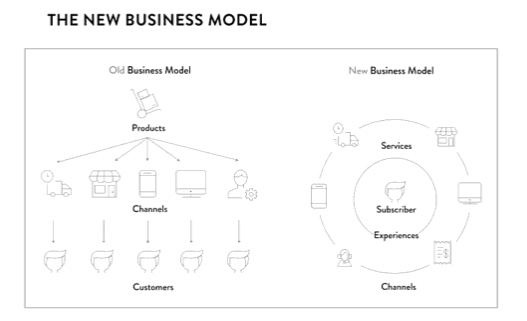
This is the new model for business. In his national bestselling book Subscribed: Why the Subscription Model Will Be Your Company’s Future-and What to Do About It, Tzuo outlines how the subscription model will benefit consumers and businesses alike.

subscription economy model

Less risk in trying new products

With a subscription service, a customer is no longer committed to owning a product. So when the latest Nicki Minaj album comes out, you don’t have to be stuck with a bunch of songs you don’t like. With a subscription service like Spotify, you can try the album out and if it isn’t any good, you can always listen to Taylor Swift.

And for small businesses, it allows them an opportunity for people to try their product without fear, giving them a chance to expand their customer base. Tzuo points to a small arts and crafts company that uses a subscription service to get customers to try their products and has built a strong following from it.

No more obsolescence

For consumers, there is no more worry of buying a tech product, only to have it become useless after a year or two. For years, people had to pay for each new Microsoft Office or operating system software update. Now, many software companies offer subscriptions with constant updates.

For example, Adobe has a subscription service for its Creative Cloud suite of video, image, and design software. This subscription helps pay for software development costs and also keeps a loyal and committed fan base by providing the latest updates.

Customer-centric service

In the old business model, companies were focused on products and their own needs. But with a subscription model, it puts the focus squarely on the customer. Consumers benefit by getting value and new options created for them all the time. Take Amazon Prime, for example: it is always adding new films, music, and books for subscribers to try out. Or companies that make apps for smartphones: these apps are constantly updated with new features.

For companies, a customer focus saves money and time by only focusing on those products and services their customers really want. A good example of this is when Fender decided to focus on their customer base. It created tuner apps and music lessons to help users learn to play Fender guitars, thereby changing new guitar buyers into long-term customers.

For customers and businesses, this subscription model will bring an amazing future of products and services that will stay relevant. While this model will change everything you’ve become accustomed to, there’s no need to be afraid of it—you can try out it for little risk, and if you don’t like it, you can stop anytime.


Kyle Crocco is the Content Marketing Coordinator at BigSpeak Speakers Bureau, a graduate of UC Santa Barbara, and the lead singer of Duh Professors. He regularly publishes business book reviews and thought articles on Medium, Business 2 Community, and Born 2 Invest.

BigSpeak Welcomes New Exclusive and the Father of the “Subscription Economy” Tien Tzuo

As seen on BigSpeak.com

BigSpeak’s newest exclusive speaker, Tien Tzuo, is the father of the “Subscription Economy,” He evangelized the shift from a product-based economy to a subscription-based model. Nowadays you can try everything through a subscription service with little commitment and the comfort of knowing you can cancel at any moment. Before you were fully consumed by the joys of subscription services Tien Tzuo was building an award-winning subscription management platform to revolutionize the way we make purchases.

After spending 10 years reworking our consumer economy Tzuo founded Zuora in 2007, an enterprise software company capable of powering any subscription-based company. Due to his cutting-edge technology, the term “Subscription Economy” was coined, referring to the turn of the century trend of renting on a subscription basis rather than buying and owning your product or service.

Before Zuora, Tzuo was one of the ‘original forces’ at Salesforce, joining as employee number 11. In his 9 years at Salesforce, Tzuo built its original billing system, later serving as chief marketing officer and chief strategy officer.

Tzuo authored the book Subscribed: Why the Subscription Model Will Be Your Company’s Future -and What to Do About it which serves as a guide for companies moving into the future of purchasing.

Tien speaks on…

  • The Subscription Economy: A Once in a Century Business Model Shift
  • Most Fortune 500 Companies are Built Wrong – Confronting Your WTF Moment
  • How to Survive the End of Ownership and Thrive with a Subscription Business Model: Common Traps to Avoid in Leading & Reinventing Your Company for the Subscription Economy
  • The Golden Age of Media – What Every Company Can Learn from Subscription Services

BigSpeak Continues to Climb the Inc. 5000 List for the Fourth Year in a Row

As seen on BigSpeak.com

For the fourth year in a row Inc. Magazine added BigSpeak Speakers Bureau to its 36th annual Inc. 5000—an exclusive ranking of the nation’s fastest-growing private companies. The list represents the most comprehensive look at the most important segment of the economy—America’s independent entrepreneurs.

With no signs of slowing down, BigSpeak has moved up 259 spots from the previous year, landing the company at No. 2909 with three-year revenue growth of 140 percent. Companies such as Microsoft, Yelp, Pandora, Dell, Domino’s Pizza, LinkedIn, Zillow, Oracle, Intuit and Zappos gained early exposure as members of the Inc. 5000.

BigSpeak began in CEO Jonathan Wygant’s garage two decades ago and has grown tremendously, impacting thousands of businesses and individuals each year with the spread of transformational messages. Wygant founded BigSpeak to address the unfulfilled need to provide top thought leaders, keynote speakers, and professional development programs that are uniquely customized to each client’s specific requirements.

This Inc. 5000 award is the fifth win for CEO, Jonathan Wygant, whose previous company, Iris Arc Crystal, was ranked 281 in the Inc. 500. Upon notification of BigSpeak’s selection to the 2018 Inc. 5000 list, Wygant said, “I am extremely proud of the team’s dedication and focus serving our Fortune 1000 clients with excellence that led to rapid and sustainable growth over the last five years. Many companies such as Microsoft, Fidelity, Johnson & Johnson, GE, and Genentech have been clients for nearly 20 years. We have exciting plans to continue on a similar growth curve over the next five years.”

President Barrett Cordero has been at the helm of the tremendous growth, focusing on sales, speaker representation, key investments, disruptive innovations and providing an exceptional work environment. BigSpeak team members enjoy flex-schedules, remote work, pet and child-friendly offices, HSA/FSA health plans, pension plan, profit sharing, and off-site team building trips.

From Hit Songs to Headphones: Two People Who Changed the Way We Listen to Music

As seen on BigSpeak.com

Hit songs and cell phones

Enter any cafe, any day, and what do you see? Someone holding their phone closer to some music speaker. You can’t go to a bar, club, or cafe without someone checking their phone so they can figure out who’s singing that crazy cool song with the wicked beat. And let’s face it, most of the time that person is probably you trying to Shazam it.

Before people Shazamed it, we lived in a world of musical ignorance. People (meaning you or maybe someone older than you who lived in that dark ages before smartphones) would hear a great song, ask around if someone knew who sang it, get frustrated when no one knew, and let the idea eat away at them until they were lucky enough to catch some DJ announcing it on the radio. What was a music lover to do?

Enter Chris Barton and the team of Shazam, like the superheroes of music search. Before there were iPhones and Google, his team had a dream. A dream that the average person anywhere (you, in other words) could use a regular dumb flip phone that came with your basic phone plan to identify songs playing in noisy bars and clubs. Before the Internet was everywhere and wifi hotspots were a thing, the idea you could dial a short number to access a database of several million songs, have your phone listen for a minute, and then find out the name of the song and artist was revolutionary. Now it’s what happens on your daily Starbucks run.

Since that day we were saved from our musical ignorance, phones have become smarter, song databases have grown larger, and Shazam has become a way not only to identify a song but also to share them on social media—and to purchase the music. The app was so useful in driving business to Apple Music, that Chris Barton and his team were able to cash out to Apple in 2017.

But not all our musical problems were solved when Shazam launched in 2002. Some of them were actually caused by Apple.

From earbuds to headphones

When Apple changed the way we accessed music by creating the iPod, the company also changed how we listened to music. No longer did you hear people talk about their surround sound, Dolby, multichannel, THX something-or-other stereo system and how it could give you the best sound quality ever, or how you had to listen to the new remixed, mastered, anniversary edition of Pink Floyd’s The Dark Side of the Moon, because it sounded like you were in the studio hanging out with the band.

In one swift movement, Steve Jobs made us all musical introverts. We all had our own private DJ device in our pocket along with a personal stereo in the form of white earbuds provided by Apple. No one was talking about sound quality anymore.

Instead, people were talking convenience, playlists, and song shuffle instead of clarity and quality. But Dr. Dre and Jimmy Iovine knew the music we heard on iPods could sound better, much better, but only if people yanked out their white earbuds and put on some decent headphones. So Dr. Dre and Jimmy Iovine teamed up and developed headphones that would truly reproduce the dynamic sound quality of the music created by artists in the studio.

The result was the multicolored Beats by Dre headphones. Introduced to the world in 2008, these anything-but-white headsets took a while to make their full impact on the music market. Despite their dynamic sound range people still used their white earbuds.

That was until brand genius Omar Johnson, voted one of the most Top 50 Most Innovative CMOs by Business Insider in 2016, helped make Beats headphones into a worldwide phenomenon. Together with his diverse team of marketers, Omar created viral marketing campaigns like “Straight Outta Somewhere” and “Powerbeats starring LeBron James” that spawned social media mania and made Beats headphones one of the most desired headphones of athletes and celebrities around the globe. Olympic medal winners and basketball MVPs alike could be seen sporting the headphones—sans payment or endorsement—and the Beats headphone brand took off like wildfire.

Now you can see people wearing the colorful Beats headphones as often as you see a pair of white earbuds. Apple noticed their popularity (and sound quality as well) and bought Beats in 2014.

What happens next to our music experience only these pioneers can tell.


Kyle Crocco is the Content Marketing Coordinator at BigSpeak Speakers Bureau, a graduate of UC Santa Barbara, and the lead singer of Duh Professors. He regularly publishes business book reviews and thought articles on Medium, Business 2 Community, and Born 2 Invest.

Event Planning Professionals Call BigSpeak For the Best

As seen on BigSpeak.com

Want to drop jaws are your next event? Event planning professionals say the sure-fire way is to bring in a killer keynote speaker. NorthStar Meeting Group, a world-class event planning company, knows the importance of an entertaining and thought-provoking keynote speaker. A great keynote speaker can set an uplifting and positive tone for what’s to come… and a bad keynote speaker will make sure half your audience slips out the door before you get to the meat of the meeting.

After surveying the top speakers bureaus in the nation NorthStar Meeting Group has found the most engaging keynote speakers in the business. Making the list are BigSpeak exclusives, Matthew Luhn, Robyn Benincasa, and Srinivas Rao.

Matthew Luhn, former Pixar storyteller, animator, and expert branding keynote speaker, has been recognized for his humor and genuineness on stage, as well as his impactful marketing and branding training with CEOs, marketing teams, directors, and other professionals. He teaches any corporate audience the importance of storytelling in business while providing them with the tools to shape their own company’s brand.

Then there’s Srinivas Rao, who founded Unmistakable Media to bring creativity back to the workforce to help your company stand out in an oversaturated marketplace. His podcast, three books, media company, and keynote speaking all work to help you be the most distinct and interesting version of yourself and your business.

Of course, adventure racing champion, firefighter, and motivational speaker Robyn Benincasa made the list as well. She founded Project Athena, a non-profit dedicated to helping women who have experienced trauma reach their most audacious adventure goals. From competing with a world-class adventure racing team to saving lives with her firehouse Robyn is an expert on teamwork and leadership. In her powerhouse keynote, she builds a stronger company culture through proven team -building skills.

To see the comprehensive list check out NorthStar’s website.

Cynthia Breazeal Asks: Where Are the Robots for the Rest of Us?

As seen on BigSpeak.com

Have you ever wondered why we don’t have personal robots? We can send robots into space, have them manufacture cars, and serve drinks in Las Vegas, but what about one for the home? Sure they can put together a mean Tesla and analyze core samples from a distant planet, but what about washing our laundry, cooking some frittatas, or making us a nice hot cup of organic, free-trade coffee? You know, the really useful stuff?

And while we’re at it, why can’t these robots be fun and tell us the insane probability of getting a date with a supermodel or reel off a few jokes about the priest, the rabbi, and the duck when we’re having a bad day? Where were the robots we were promised by Star Wars? Where’s our personal C3PO?

If this kind of question has been keeping you up all night, you’re not alone. It’s also the same question that bothered social robot pioneer and keynote speaker Cynthia Breazeal. When she was a bright-eyed graduate student at M.I.T., she saw how robots were being sent into fiery volcanoes, down deep into the depths of the ocean, and onto the red dirt of Mars and wondered why aren’t these robots interacting with humans? Where were our robot companion sidekicks? How could robots help us be better humans?

Then Cynthia had her epiphany—interacting with inanimate objects and interacting with a living, thinking being were two entirely different paradigms. Energized, she marched into her advisor’s office and declared she had to change everything about her entire Ph.D. research. And so began her journey into the world of social robotics.

What is social robotics? And can you trust robots?

You probably have heard of machine learning, digital voice assistants, and industrial robots (more on that below), but social robotics isn’t about playing chess, commanding Alexa to order a Hawaiian pizza, or building an iPhone in a vacuum-sealed room. It’s about interacting socially—with mechanical devices.

Cynthia is on the forefront of the emerging field of social robotics. As director of the Personal Robots Group at MIT, she studies how we can live better with robots. Her research has focused on how these socially trained robots can help us maintain weight loss, learn Spanish, and teach us about human behavior. For example, how does trust work? And did you know that you could trust a robot?

Cynthia’s research has shown when we interact with a machine that can physically move in some way, we feel more comfortable, we get more out of the experience, and we even come to trust and like the robot. This kind of information shows us how much physical behavior is important for building trust as well as showing us how we can get more out of computers when they are anthropomorphized.

The humanoid robots of Star War are not here yet. We still have a long way to go until they serve as our wingmen in bars. While great strides have been made in terms of mobility and dexterity, other technical limitations remain in terms of weight and battery life. The Atlas “backflip” robot you may have seen jumping around on YouTube, billed as the “The World’s Most Dynamic Humanoid” can carry only 25 pounds and run for an hour or so. Definitely not ready for an all-night rave or taking on the death star. And that robot can’t even interact with humans in a social way either. So you know it’ll never buy the first round.

Right now we only have the beginnings of socialization as realized by Cynthia’s startup robot: Jibo. Jibo is “The World’s First Social Robot for the Home.” The robot doesn’t have legs or wheels, and can’t bring you a cup of coffee yet, but Jibo has face and voice recognition technology and will notice when you come into a room. Unlike Alexa, Jibo isn’t tied into a database, so the experience interacting with Jibo is more human-like than talking to a digital voice assistant.

While droids aren’t slinging out sarcastic comebacks yet, the rise of personal robots is on its way. Until then, we’ll just have to be satisfied with machine learning, digital voice assistants, and industrial robots. To learn more about those topics, read below.

Machine Learning

The best computers can learn to become better in a certain defined field. Keynote speaker Andrew McAfee has shown us how we are entering a second machine age with computers beating humans at games like Chess, Go, and Jeopardy. Likewise, algorithms can help us better trade, sell products on Amazon, find a date, and choose movies on Netflix, according to marketing expert and neuroscientist Carmen Simon.

Digital Voice Assistants

We are all familiar with digital voice assistants. Who has not said, “Hey Siri,” “Hey Google,” or “Hey Alexa?” These voice assistants not only help us with rote tasks, like setting alarms, choosing awesome playlists, and reordering diapers, they also entertain us with their limitations in countless internet memes. A.I. pioneer and Siri inventor Adam Cheyer has predicted digital voice assistants are going to be the new way we interact with computers. And keynote speaker and innovator Tan Le’s Emotiv brainwear will have us interacting with computers and technology just through our brainwaves alone. Just watch as this quadriplegic man in Brazil can drive a formula car with thoughts alone.

Industrial Robots

Industrial robots are the machines saving us from the drudgery of assembly line work. They can tirelessly repeat repetitive tasks without the need for rest or mandated coffee breaks. Perennial disruptive innovator, TED talk regular, and keynote speaker Kevin Surace has shown industrial robots are going to continue doing away with manufacturing jobs and rote tasks in the future, freeing us to do more engaging tasks.


Kyle Crocco is the Content Marketing Coordinator at BigSpeak Speakers Bureau, a graduate of UC Santa Barbara, and the lead singer of Duh Professors. He regularly publishes business book reviews and thought articles on Medium, Business 2 Community, and Born 2 Invest.