Russell Bishop, Fortune 500 leadership consultant and educational psychologist, recently led a New Year seminar to help corporate executives plan for their best year yet—in and out of the office. I was fortunate enough to attend the seminar and gained some valuable insight about how leaders set goals.
The intimate conference allowed the leaders to speak openly about their personal and professional hopes and fears. Bishop tailored the seminar to the group’s needs and let the goal setting flow with his guidance.
He left the leaders with six main takeaways for creating a productive year and increasing happiness based on the challenges the leaders expressed. Although you may not run a Fortune 500 company (yet), acting like a leader is the best way to become one.
6 Lessons for Leaders from Russell Bishop on having a more productive year
Praise your accomplishments, while analyzing your disappointments
It’s essential to take an honest inventory of your past success and failure. Oftentimes, praising accomplishments is harder for people than identifying where they fell short. Bishop explains this is because of negative self-talk (how our self-image creates either positive or negative internal dialogue) that’s been instilled in us.
He gives the example of a grade school spelling test score. When you receive a grade at the top of your spelling test that reads “-6” instead of “44/50”, you’re trained to focus on the negative, what you lost. In actuality, this score is a B+ and something to be proud of. With the “44/50” model you also have something to build off of.
By taking inventory now, we can identify negative self-talk and adapt our goals.
Choose areas of focus for your goals
To choose an area of focus, Bishop recommends looking at your personal growth, friends, wealth, fun/adventure, service/philanthropy, career, family, and health. He suggests these topics as a starting point for formulating new goals but encourages you to explore other areas in your life where you place great importance such as spirituality or faith.
Once you’ve chosen your areas of focus, it’s time to visualize what you want in each area. What will make you happy and fulfilled?
Understand the goal symbolizes for you
Now, look at your list of things you want. Try to understand why you want them, and what they symbolize to you. For example, your goal may be to get a 5 percent raise at work. First, figure out why you want this raise: money, acknowledgment, status? Then, determine what these things symbolize to you. You want more money, which really means you want stability or freedom. You want higher status, which really means you want power or pride.
With the experience at the forefront of your mind, it’s time to take a good, hard look at whether these tangibles will actually produce the experience you want. You should also consider whether or not reaching these goals will stunt your experience so severely that it may not be worth it.
Imagine that you have to work overtime five nights a week to get that 5 percent raise that will ensure you have enough money to be free to go on lavish vacations. You’re sacrificing so much freedom to reach your that goal that it may not be worth it.
Set SMART goals
Once you fully understand the true reasons behind your desires you can set goals, but make sure they’re SMART goals.
Specific—Clear, objective
Measurable—How much, how many?
Attainable—At least an 80% chance of success, not so far-fetched they’ll never happen
Relevant—Achievement matters in critical areas of focus
Time-bound—You know when it’s due
By keeping your goals SMART, you are setting yourself up for success and making your goals reviewable. Often, people get lost in trying to decide the actual goal and they flounder between getting a 5 percent raise or finding a new higher paying job altogether.
Bishop says there’s no way to predict what will make you happier in the future, but one thing that definitely won’t make you happier is doing nothing. You need to start moving in any direction and the best part about goals is they’re adaptable. If something isn’t serving you as it should change it.
Positive self-talk
Bishop says as soon as you give your brain a focus it filters through the world through that focus. If you chose to focus on something positive, you’ll see more positive things in life. The same goes for negativity. If you are focused on feeling bad and you tell yourself, “Don’t feel bad,” your brain will only focus on “feel bad.” This is why your self-talk must always be positive.
As a psychologist, he swears by affirmations. By creating positive affirmations about feelings and not actions he truly believes you can build habits. Instead of saying, “I love to floss every day,” he repeats, “I love the healthy way my mouth and gums feel when I floss every day.”
With repetition and a focus on physical feelings, you will genuinely convince yourself. The best part, Bishop says, is that you should never do the action if you don’t feel like it. Only floss when you feel like have a healthy mouth. This will reinforce the validity of your affirmations.
Another key part of self-talk is finding paradigms that you’ve come to believe are true. While some paradigms can be expansive (“I can do anything I put my mind to!”) others can be limiting (“I need other people’s approval.”) Bishops says there’s no room your worldview for limiting paradigms and one of the most helpful things you can do is to rid yourself of these through affirmations.
Review your progress at least monthly
Check-in, whether it’s with an accountability partner or just yourself. You need to be monitoring your progress and reminding yourself of your focus. Some people avoid monthly check-ins because they’ve forgotten their positive self-talk and see this as a time to be critical of any missteps. While being honest about disappointments is healthy, take this time to praise the small accomplishments.
Jessica Welch is the Content Marketing Associate at BigSpeak Speakers Bureau, holding a Bachelor’s Degree in English Literature and Anthropology from California Polytechnic State University, San Luis Obispo. Her business thought articles often appear on Business 2 Community, Born 2 Invest, and YF Entrepreneurs.
At BigSpeak, we believe that motivation is the key to your success, whether you need to be motivated to consistently do a good job at work or to finish some big, hairy, audacious goal after years of struggle. Our top inspirational and motivational speakers inspire and delight business audiences all over the world. But where do they find their energy and inspiration?
To find out, BigSpeak reached out to our top motivational and inspirational speakers to discover what is motivating our biggest motivators in 2018. Their answers were as varied as they were surprising.
Top Motivational Speaker, Former Tony Robbins Int’l Point Man, Author, and Sales Leader
I am going back to the basics. I have one of the great personal development cassette libraries around. We just moved and I donated about 80% of them and kept the BEST. I am going old school and listening to the best cassette series from Jim Rohn, Denis Waitley and Napoleon Hill.
There are very few “new” ideas out there. Their wisdom is just as valuable today as it was when I first listened to it over 30 years ago.
#1 Bestselling Author and Digital Leadership Expert, Pulitzer Prize nominee, and Top 50 Professor
I’m inspired to do less this year! You don’t see that on too many t-shirts do you? As I’ve been privileged to interview, research, and surround myself with today’s Digital Leaders one common thread stands out. They’ve all learned that it’s not about adding stuff, it’s about taking away. This is the opposite of what 99% of us do when setting goals and resolutions. We start adding items to our already full plate. Not this year.
This year I’m motivated to do what I’ve learned from interviewing the world’s top performers. I’m going to do less. I’m going to stop multitasking. I’m going to focus. Specifically, each morning and throughout the day I’m going to pause, breath and ask the simple question: “What is the one thing, that if I do it well, makes everything else easier or unnecessary.” This is what motivates me and I hope it inspires you too!
Top Innovation Speaker, Tech Entrepreneur, and New York Times Bestselling Author
For me, two things:
1) The opportunity to elevate the world by unlocking creativity and innovation. If I can help organizations unleash just 5 percent more of these attributes, they enjoy tremendous success, create jobs, and help the world. This is my big dream…to elevate the world’s creative capacity.
2) I’m the proud dad of 1-year-old twins (boy and girl). Talk about inspiring and motivating!
Top Leadership Speaker, Executive Coach, and CEO of Libby Gill & Company
My inspiration for 2018 is the science of hopefulness, called hope theory. I’ve spent years researching this topic and I’m delighted to have compiled my research, along with case studies and client stories, into my new book, The Hope-Driven Leader: Harness the Power of Positivity at Work.
With this book–endorsed by bestselling authors Stephen M.R. Covey, Bob Burg, Joe Calloway, CEO of Wicked Good Cupcakes and star of Shark Tank, Tracey Noonan; and numerous business and thought leaders–I’ll be able to help people experiencing change, challenge, and chaos. I plan to guide emerging and established leaders to create more purposeful and productive workplaces by shifting mindsets from siloed to collaborative and productivity levels from sluggish to robust.
My ultimate goal is to disprove the old adage “Hope is not a strategy,” and show the world–now when we need it most–that hope IS a strategy!
Top Leadership and Teamwork Speaker, World Champion Adventure Racer, CNN Hero, and Bestselling Author
In 2018, I’m Inspired to help people (and animals:)) discover and reach their huge, hairy dreams and goals…
1) In my speaking business, I love helping corporate clients and their teams embrace the idea that building, leading and inspiring a team for the journey is how we consistently WIN!
2) In my nonprofit, The Project Athena Foundation, I love helping Survivors of medical or traumatic setbacks cross crazy-challenging, adventurous finish lines as part of their recovery. It’s truly a joy to watch our amazing Athenas (and Zeuses!) shock and Inspire themSELVES—and to show them that they’re never defined by their setbacks…they’re defined by their COMEBACKS!
3) In my next nonprofit endeavor, the Valentine Animal Sanctuary, in Sedona AZ (which I hope to break ground on at the end of the year!), I and my family/team want to help homeless creatures, great and small, to live their dream of a happy, healthy, long, and LOVED life by providing a forever-happy home. ❤️❤️❤️❤️❤️❤️❤️❤️❤️❤️❤️❤️❤️❤️
Leadership Speaker and Expert, retired Brigadier General, and Executive Director of the Doerr Institute for New Leaders
Inspiration and the motivation that follows are simply choices. I choose to be inspired, from the inside out. The beauty of this attitude is that it can take you through really difficult realities.
Kyle Crocco is the Marketing Coordinator for BigSpeak, has a Ph.D. in Education from UCSB, and likes to play guitar in his free time.
If you’re feeling a little sluggish by the end of January, you’re not alone. The holidays are over, the holiday weight is still on, and the early enthusiasm for new goals has waned considerably in the face of everyday obstacles. By the end of the first month, only 60 percent of people are still working towards their New Year’s resolution.
If you find yourself wavering on an old goal, about to start a new goal, or just need a little motivation to keep up the good work you are doing, here are six ways to keep your motivation fresh, inspired from ideas in the bestselling books of our top motivational and inspirational speakers.
Do something meaningful
If you aspire to be successful in what you do, you should always choose to pursue something meaningful. You will know if some activity or goal is meaningful if you find it is something you would do even if you weren’t paid, or you would do despite criticism. Think about the activities that engage you so much that you lose track of time.
(From Mark Thompson, Executive Leadership Coach and Bestselling Co-author of Success Built to Last)
Use unrounded numbers to get off the couch
If you want to get off the couch and exercise more, choose an unrounded number for your target goal. For example, would you rather run a 10k or 9.9k, do 30-minute or a 29-minute swim, go on a one- hour hike or a 59 minute hike?
While the number difference is small, the effect can be quite large for motivation. Robert Cialdini says by using unrounded numbers, the task seems more achievable.
Set a number range to better meet your target goal
In the same vein, you are more likely to complete a goal when you set a number range rather than a single number. For example, if your goal was to lose weight: Would you lose more weight if you were asked to lose 1-3 pounds a week, or 2 pounds a week?
In a study on weight loss, Cialdini stated the 1-3 pound group lost more weight—an average of 2.67 pounds in the first three weeks compared to just 2.2 pounds for the 2 pound a week group.
Cialdini says that people find a number range more attainable. When you have a single number, you might give up if you don’t achieve that number, but with a number range, you are more likely to meet the goal.
(2 and 3 from Robert Cialdini, Behavioral Expert, Bestselling Author of Influence)
Celebrate small wins
When you set goals, don’t wait until they are entirely complete to celebrate. To keep your motivation up, you should break your goal into smaller steps and celebrate those small wins.
If your goal was to start a new business in 2018, don’t wait until you open your doors to celebrate. Celebrate the progress along the way: completing the business plan, getting funding, etc.
There’s nothing like a small victory to keep you motivated for the next victory.
Never let the pursuit of perfection hinder progress
Conditions are rarely ever perfect. The results that we envisioned and reality are often at odds, but it shouldn’t keep us from moving forward and doing the very best we can with what we have in the moment, every minute, every day. Success is a journey, not a destination.
Be flexible
In our experience, “Semper Gumby” (Forever Flexible!) is also one of the hallmarks of a winner, as change is the only consistent thing when we’re trying to achieve world-class results in a constantly changing environment!
(5 and 6 from Robyn Benincasa, Teamwork Expert, Bestselling Author of How Winning Works)
Kyle Crocco is the Marketing Coordinator for BigSpeak, has a Ph.D. in Education from UCSB, and can be easily persuaded to do karaoke.
Everybody wants to be their own boss and watch their startup grow into a prosperous business, but most startups are missing the secret ingredient–purpose. When purpose is added to passion you become invincible. Passion for money and day-cruising in your yacht may seem like enough to drive a company, but you’d be surprised how fast that motivation fades when you run into speed bumps.
The true motivator that will never waiver or wilt is a purpose. Nowadays, you have a 90 percent chance of your startup failing, whether it’s due to market conditions, your product, or funding. But the simple truth is that every startup is going to hit roadblocks that could easily mean failure…or they could mean it’s time to dig deeper. The difference between the strong companies and the floundering startups is the belief that what you’re doing is worth pushing on.
The formula is simple passion + purpose = determination. These top keynote speakers have managed to turn their passions into businesses, nonprofits, and foundations that survived the test of time by feeding off each one’s distinct purpose.
Jess Ekstrom
Jess Ekstrom founded Headbands of Hope, a company that donates a headband to a child with cancer for everyone one headband purchased. She came up with the idea after interning with the Make-a-Wish Foundation, where she saw how much girls who had lost their hair to chemotherapy loved dressing up in headbands. As a junior in college, she created and launched her startup, which has now grown to be a massive success.
Ekstrom struggled with the millennial stigma associated with young college kids trying to make it big in the corporate world. After her initial launch only yielded two sales (her mother and grandpa,) her determination had to kick into overdrive.
Ekstrom believes there’s a “moment in our lives that completely wipes clear everything we thought we knew.” Hers was seeing how her company brought confidence and happiness to so many children. She refocused her brand and has now given 202,314 headbands to children around the world.
Neither brother has a background in business and their company grew faster than they could learn. They made countless mistakes along the way, but their purpose of helping children and spreading positivity carried them on regardless of their business blunders.
She started her company, Embrace Innovations, as a nonprofit. But after losing funding and seeing her company on the edge of failure before it even began, she switched to a TOMS-model and created its sister company Little Lotus Baby, a baby product line for the US market. Now an Embrace baby warmer is donated to a developing country every time a parent buys a Little Lotus Baby product.
Her purpose didn’t allow her to give up, even when failure seemed imminent.
Sebastian Terry
Sebastian Terry started with a bucket list. After his friend died at the early age of 24, he re-examined his life and asked, “What would I do differently if this was the only time on earth I had?” Everything: the answer the spawned his 100 Things List.
After checking box after box, he said he found his real purpose when he came #26, “Help a stranger.” Once he had helped himself to find out who he truly was, he realized he could now help others.
Scott Harrison is the founder of Charity: Water, a charity that provides clean water to those in need around the world. He was inspired by his volunteer trip to Liberia where he documented doctors’ work removing facial deformities for those who could not afford it. On this trip, he realized most of the issues the inhabitants encountered were caused by drinking dirty water.
Previously, Harrison had spent ten years working as a nightclub promoter in New York. He felt he needed to change his life, stop polluting the world, and give back. He struggled to launch the charity because of people’s apprehension around where their money really goes within a charity.
Jean-Michel Cousteau is an underwater explorer, environmentalist, educator, and filmmaker. The son of Jaque Cousteau, he grew up with an affinity and appreciation for the ocean as we are all connected through it and to it. He has dedicated his life to “carrying on the flame” of his father’s activism centered around protecting our oceans.
As Founder, Chairman of the Board, and President of Ocean Futures Society, a non-profit marine conservation and education organization, Jean-Michel travels the world, meeting with leaders and policymakers at the grassroots level and at the highest echelons of government and businesses. He is dedicated to educating young people, documenting stories of change and hope, and lending his reputation and support to energize alliances for positive change.
Jean-Michel’s passion for preserving and protecting the ocean has been his life’s purpose. At the age of 80 he celebrated 73 years of diving and feels he can’t and won’t stop until he sees a brighter future for our oceans.
Michael Balaoing
Michael Balaoing is a top communications speaker, entrepreneur, and social activist. He is the founder and CEO of Candellion LLC, a strategic communications group that focuses on guiding people to become better public speakers. His philanthropic work is a little more behind-the-scenes than some of our other speakers, but it is just as impactful.
He brings his communications expertise to foundations focused on women’s empowerment and entrepreneurship. He worked with the Tory Burch Fellows to prepare them for their pitches and give them a leg up in the competitive business world. Tory Burch Foundation works to empower women entrepreneurs and aids them in numerous ways, like arming them with top speaking advice from Balaoing.
Jessica Welch is the Content Marketing Associate at BigSpeak Speakers Bureau, holding a Bachelor’s Degree in English Literature and Anthropology from California Polytechnic State University, San Luis Obispo. Her business thought articles often appear on Business 2 Community, Born 2 Invest, and YF Entrepreneurs.
One of our favorite talks is by Derek Sivers. In his short comic presentation, he shows by traveling across the world you can find the opposite of what you believe can also be true. For example, in the U.S and Europe, we have names for streets but not for our city blocks. But in Japan, they name their city blocks and have no names for their streets. Or in China, you pay a doctor when you are well because he or she is doing a good job, but not when you are sick.
So questions your assumptions about how systems work. The opposite might just be as true.
“When you are not afraid of rejection and it feels like you have nothing to lose, amazing things can happen.” – Jia Jiang
This quote may sound familiar to you if you watched Jia Jiang’s TED Talk that ranked one of the most viewed talks of 2017 about his 100 Days of Rejection. With over 3.5 million views, his idea of exposing yourself to rejection to build immunity became the focus of many thought partners and sales leaders.
But for many, the drive stopped there. You watched the talk and felt good about your next rejection, maybe even turned that ‘no’ into a ‘yes,’ but that was as far as your motivation took you. You forgot Jia’s rejection-proof demeanor as soon as a rejection cut you deep enough to break the skin.
If this is you, don’t worry. Jia’s bestselling book, Rejection Proof: How I Beat Fear and Became Invincible, One Rejection at a Time, will not only resurrect the momentary confidence his talk inspired in you, but it will also help you hold onto a rejection-proof mindset and guide you through the process of becoming fearless once and for all.
Here are some golden takeaways from Jia’s book, served up with hands-on ways to live a rejection-proof life.
18 Lessons Learned From Rejection Proof by Jia Jiang
Rejection Is Human: Rejection is a human interaction with two sides. It often says more about the rejector than the rejectee, and should never be used as the universal truth and sole judgment of merit.
Rejection Is an Opinion: Rejection is an opinion of the rejector. It is heavily influenced by historical context, cultural differences, and psychological factors. There is no universal rejection or acceptance.
Rejection Has a Number: Every rejection has a number. If the rejectee goes through enough rejections, a no could turn into a yes.
Retreat, Don’t Run: By not giving up after the initial rejection, and instead of retreating to a lesser request, one has a much higher chance of landing a yes.
Collaborate, Don’t Contend: Never argue with the rejector. Instead, try to collaborate with the person to make the request happen. Be patient and respectful.
Give A “Why”: By explaining the reason behind the request, one has a higher chance to be accepted.
Start with “I”: Starting the request with the word “I” can give the requester more authentic control of the request. Never pretend to think in the other person’s interests without genuinely knowing them.
Acknowledge Doubts: By admitting obvious and possible objections to your request before the other person, one can increase the trust level between the two parties.
Target the Audience: By choosing a more receptive audience, one can enhance the chance of being accepted.
Be Direct: When giving a rejection, present the reason for the rejection. Avoid long, convoluted setups and reasoning.
Self-Improvement: One can use rejection as an effective way to improve an idea or product.
Worthiness: Sometimes it is good to be rejected, especially if public opinion is heavily influenced by a group and conventional thinking, and if the idea is radically creative.
Character Building: By seeking rejection in tough environments, one can build up the mental toughness to take on greater goals.
Find Value: Repeated rejections can serve as the measuring stick for one’s resolve and belief. Some of the greatest triumphant stories come only after gut-wrenching rejections.
Freedom to Ask: We often deprive ourselves of the freedom to ask for what we want in fear of rejection and judgment. But amazing things often happen only after we take the first step.
Detachment from Results: By focusing on controllable factors such as our efforts and actions, and by detaching ourselves from uncontrollable outcomes such as acceptance and rejection, we can achieve greater success in the long run.
A good business keynote speaker is someone who entertains while informing, but a great one is someone who leaves everyone in the room feeling empowered, like the world outside that conference door is theirs to command. BiSpeak knows the difference between good and great business keynote speakers and we know how hard it is to find someone who reaches greatness. Which is why we at BigSpeak want to make it easier for you to find your next great speaker by sharing our most booked business keynote speakers in the speakers bureau industry.
Whether you’re looking to motivate, inspire, inform, or entertain, these four great business keynote speakers will leave your audience ready to take on the business world.
Marc Randolph is a top entrepreneur and innovation speaker, who is best known as a co-founder of the Internet streaming service sensation, Netflix. Under his direction, he guided Netflix to their initial public offering in 2000. After leaving Netflix in 2002, Randolph co-founded the analytics software company Looker Data Sciences.
As a business speaker, Randolph’s keynotes focus on how companies can be more like startups in terms of ideas and innovation, and the Netflix story. Audiences find his presentations funny and inspiring with useful business takeaways that will help them think like a Silicon Valley startup.
Mitch Lowe is a top entertainment and business speaker, CEO of MoviePass, co-founding executive of Netflix, and a former President of Redbox. As an investor, executive, and entrepreneur he has helped transform and continues to transform the movie entertainment and vending industries. Under his direction, MoviePass has climbed from 20,000 to 1.5 million subscribers in slightly over a year and looks to disrupt the movie theater industry by bringing down prices and increasing theater attendance.
As a business speaker, Lowe’s keynotes focus on tough leadership decisions, building a winning culture, and teamwork. Audiences find that he is a terrific presenter, a pleasure to work with, an incredible resource, and a great thought partner.
Matthew Luhn is a top creativity speaker, story consultant, and a former Pixar Animator and Story Artist with 20 years’ experience at Pixar Animation Studios. His work has appeared in numerous Pixar films, including Toy Story, Monsters, Inc., andCars.
As a business speaker, Luhn’s keynotes and workshops focus on using storytelling skills to help Fortune 500 companies, entrepreneurs, and professionals bridge the gap between business and heart so they can build stronger brands, make more engaging pitches, and craft better content. Audiences find Luhn to be an amazing presenter, easy to work with, inspiring, funny, and the highlight of the conference.
Robyn Benincasa is a top leadership and teamwork speaker, world champion adventure racer, CNN Hero, and bestselling author. She has won the World Adventure Race two times, holds three Guinness World Record for long-distance kayaking, and has participated as an Ironman triathlete 10 times. Her book on teamwork and leadership, How Winning Works, was a New York Times bestseller. She has been a San Diego firefighter for 19 years and is considered a CNN Hero for founding Project Athena Foundation, which helps survivors live their adventurous dream as part of their recovery.
As a motivational business speaker, Benincasa’s keynotes focus on building world-class teams and creating a culture of champions. Audiences find Benincasa’s talks to be motivating and uplifting, while re-cetenering teamwork as a corporate necessity.
The content writers at BigSpeak Speakers Bureau are Experts on the Experts. They hold doctoral, masters, and bachelors’ degrees in business, writing, literature, and education. Their business thought pieces are published regularly in leading business publications. Working in close association with the top business, entrepreneur, and motivational speakers, BigSpeak content writers are at the forefront of industry trends and research.
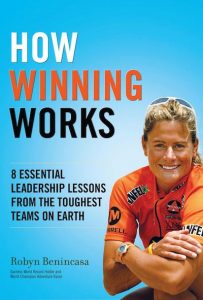
Robyn Benincasa -How Winning Works: 8 Essential Leadership Lessons from the Toughest Teams on Earth
1. Total Commitment
“People who have lost heart have never yet won a trophy.” — Greek Proverb
“Commitment starts when the fun stops!” — Robyn Benincasa
“I’m a great believer in luck. I find that the harder I work, the more I have of it.” — Benjamin Franklin
Inspiring and Demonstrating “The 4 P’s of Total Commitment”:
Planning—You MUST have a clear and easily understandable plan (direction, methods, checkpoints, destination) that is consistently communicated to the rest of the team. Ensure that all team members understand their role within that plan and the ways in which they can help one another get to the finish line.
In our experience, “Semper Gumby” (Forever Flexible!) is also one of the hallmarks of a great navigator/leader, as change is the only consistent thing when we’re trying to achieve world-class results in a constantly changing environment!
Purpose—Inspire yourself and your team by focusing on and reaching for something greater than yourselves. Money is powerful as a goal, but great people not only want to do “well” for themselves, they want to do “good” for others and their communities. Give people a way to create a “greater good” through your organization, and watch them rise to the occasion, personally and professionally.
Perseverance—Great winners always find a way, every day, to move forward toward their goals, mentally, spiritually, and physically. Make sure you reward people for their consistent, small, day-to-day steps, and not only the big leaps. Success is often based on consistency, and ultimately, the small steps have a greater long-term impact than the big ones when it comes to reaching huge, hairy, audacious finish lines. In the fire academy, we learned that water is extremely hot at 211 degrees, but it boils at 212 degrees. You never know when that 1 degree of extra effort is going to change outcomes. Perseverance, and going the extra step every day (versus occasionally going the extra mile), is the key!
Preparation—Luck = Opportunity + Preparation. All consistently high performing teams have one thing in common: their world class preparation. How do you think they get so “lucky”!? And not only are they out-preparing their competitors, they are always scanning the horizon for opportunities and creating opportunities by understanding, mining and capitalizing on their unique strengths and core competencies. What do you do better than anyone else in the industry? And are you preparing every day to capitalize on those strengths?
Remember: COMMITMENT STARTS WHEN THE FUN STOPS! You don’t find out if your team is truly committed until they’re faced with times of great challenge and change. For World Class Teams, these times are a catalyst to make them even better…together!
Inspiring and Demonstrating Empathy and Awareness:
Connect to the person before the point
When interacting with another teammate during the course of the day, take just 30 seconds to let that person know that you SEE THEM (the friend, the co-worker, the wife, the dad, the XYZ) before you dive right into what you need from them. It doesn’t take much, often just a “How did your son do on his final exams?” or “How was your daughter’s soccer championship” or even “How ARE you?” (and really actually wait for the answer). This strengthens that bridge to our teammates when they know we care about THEM, as human beings. And when times are tough or there are huge hairy goals ahead, those interpersonal bonds are the key to success. When it comes to motivation and perseverance, we’ll drive harder for our “friends.”
Coaching versus criticism
When we need to address performance with a teammate, always try to err on the side of coaching versus criticizing. How do you ensure that your teammate can tell the difference? When you criticize, you are perceived as “pointing a finger” at your teammate. When you coach, you are genuinely extending a hand and asking how you can help. A slight distinction in intent and delivery makes all the difference. And you will get a heck of a lot more buy-in from your teammate when they understand that you believe in them, are in their corner, and are offering to help them succeed.
Remember that we work for people, not for companies
World Class Teammates are constantly demonstrating and inspiring, in word and indeed, how to be the kind of leader/team member that other people want to work WITH and work for. When the best path/response/action isn’t clear, think about the best, most motivating leader or teammate you have had in your life, and ask yourself “what would X do right now”? You can never go wrong when you consistently DWR (Do What’s Right). It’s a simple code to live by, you will never have any regrets, and you’ll inspire others to DWR along the way!
3. Adversity Management
“The ultimate measure of a man is not where he stands in moments of comfort and convenience, but where he stands at times of challenge and controversy.” — Martin Luther King, Jr.
“Change is the only thing that stays the same…it’s our response to those changes that dictate our success.” — Phoenix Fire Department Chief, Alan Brunacini
Inspiring and Demonstrating Adversity Management:
See challenges versus roadblocks:
Your attitude and your response to times of great challenge and change dictate your long-term success. The best of the best inspire themselves and their teammates to always see a “challenge,” never a roadblock. The human spirit is wired to rise to the occasion!
Be ruled by the “hope of success” versus the “fear of failure”
When faced with a difficult challenge or times of change, observe yourself in action. Are you driven to do what it takes to WIN or are you simply doing what it takes to NOT LOSE? Where you set your focus completely changes who you are and HOW you operate, and leads you down two different paths, to two vastly different finish lines. Try focusing on and planning your next moves based on where you WANT to go instead of focusing on all of the things you are worried might happen. This works for mountain biking too, btw! 🙂 Every time I’ve found myself in the dirt next to my bike, it was because I was focusing on the dreaded obstacle in the trail instead of the clearest path to success!
Embrace setbacks and challenges as a springboard to future success
One of the many hallmarks of a World Class Team is their ability to realize, in the moment, that their challenges will lead them to something much better in the future, and they embrace those times of change and uncertainty as a chance to get a jump on future success. Pain brings progress. With the right attitude and a certain fierceness we tackle our challenges head-on and often look back a few years later and say to ourselves and our teammates, “In a lot of ways, that crazy time was the best thing that ever happened to us.” And it’s true!
Never let the pursuit of perfection hinder progress
Conditions are rarely ever perfect. The results that we envisioned and reality are often at odds, but it shouldn’t keep us from moving forward and doing the very best we can with what we have in the moment, every minute, every day. Success is a journey, not a destination. And the best teammates inspire everyone around them to persevere, make the best of a crazy situation, and never ever lose that drive to do “whatever it takes” to get to the finish line.
4. Mutual Respect
“Loyalty means not that I agree with everything you say or that I believe you are always right. Loyalty means that I share a common ideal with you, and that, regardless of minor differences, we strive for it, shoulder to shoulder, confident in one another’s good faith, trust, constancy, and affection.” — Karl Menninger
Inspiring and Demonstrating Mutual Respect:
Remember the Aluminum Can Theory
The Aluminium Can Theory is an entertaining concept created by Alan Brunacini, one of the most inspiring and engaging Fire Chiefs in history (and one of my personal heroes). He said, “When you have a disagreement with someone on your crew and you’re compelled to go right to the one terrible comment that you know will take them to their knees…remember that comment is an aluminum can…it’s going to stay in the environment forever.” World Class Teams never let those aluminum cans come between teammates. They consistently avoid gossip, criticism, and backstabbing, as those behaviors will destroy a hard-won trust. Conversely, there are Positive Aluminium Cans (i.e., telling a teammate how impactful, amazing, or talented they are and why), and great teammates will share them in abundance.
Mentor unselfishly
World Class Teammates understand that “Knowledge SHARED is power,” and they are consistently bringing one another up to speed on best practices, the latest techniques, new discoveries, etc. Everyone gets better…together, and the rising tide raises all ships! Always be wary of “teammates” who derive their power by knowing things that others don’t know.
Act like a team always…the feelings will follow
Let’s face it! We’re not always going to feel all fluffy and purple dinosaurs (I love you, you love me) about each other! But World Class Teammates will always ACT like a great leader or act like a great teammate, regardless of the feelings. Bottom line: Acting like a team is more important than feeling like a team. The positive feelings will always come back when our actions inspire them.
Believe in teammates beyond reason
What happens when someone believes in us? It makes us want to rise to the occasion and prove them right. And if someone doesn’t believe in us? We tend to want to prove them right as well. Believing in someone is a powerful force… and a gift that great teammates give to one another every day.
Give respect as a gift—not as a grade
Building and leading a World Class Team inherently means that everyone is given 100% respect for their experience, opinions, contributions, knowledge, etc., right off the bat, versus creating an environment in which little respect is given and must constantly be earned. Trust me, as a firefighter, I live in a world where respect must always be earned and can be withdrawn at any moment. It’s definitely not conducive to world-class teamwork or results when teammates are constantly battling one another for recognition or pride. When respect is given as a gift and not withheld as a grade, teammates feel valued, worthy, engaged, free to learn, and have increased ownership of outcomes. Respect is also the super glue that bonds teammates together in times of great challenge and change.
5. ‘We’ Thinking
“None of us is as smart as all of us.” — Ken Blanchard
“The secret is to play less as an individual and more as a team. As a coach, I play not my eleven best, but my best eleven.” — Vince Lombardi
Inspiring and Demonstrating “We” Thinking:
Choose a goal that can’t be accomplished alone and build a world-class team to achieve it
The best of the best in any challenging endeavor didn’t get to the finish line alone; they had mentors, great teammates, sponsors, a supportive family, and they consistently surrounded themselves with people that could push or tow them to the next level. In our business lives, we should always be reaching out to others in pursuit of our goals for ourselves, and, most importantly, our clients and customers. Just like a tree, we can only grow so tall before we need to widen our base and extend our roots; only then can we grow even taller. It’s not a weakness to seek teammates when faced with a big challenge or a huge hairy audacious goal…it’s a strength!!
“Suffer equally”—offer and accept tow lines
This is a funny term that one of my teammates came up with to describe how a world-class adventure racing team operates. World Class Teams are always finding a way to “suffer equally” during the race, whether that means taking some weight from a struggling teammate’s pack when we feel strong, or grabbing a tow line from a teammate when we’re at our lowest point. Teammates who are consistently sharing their strengths AND their weaknesses will always get to the finish line before a team of superstar soloists.
Seek synergy everywhere
The best leaders have a knack for creating synergy in every interaction, because they are consistently operating with the intention of a teammate: They always try to find the win/win, they bring more value than they take, and they walk out of their front door every day and see a world full of teammates versus a world full of competitors. This energy draws people to us and brings out the teambuilders in them. It’s amazing how much people will give when the person across the table from them has the intention to give back.
6. Ownership of the project
“People tend to embrace that which they create.” — Anonymous
Demonstrating and Inspiring Ownership of the Project:
Hire the inspired
When you bring new people onto your team within your business or in your life, make sure they are not only capable of performing at a world-class level, but they are truly inspired at a deep level by your vision, mission, values and the people served by your organization. Many jobs can be learned, but inspiration is an inside job, and in many cases, that real sense of purpose and ownership of outcomes is of equal importance to the technical side of the job.
Inspire your hires
How do we inspire people who are currently on our team? Here are a few key ways to create real ownership of your mission and outcomes:
Discover teammates’ strengths and let them lead in those areas of strength, experience, and ability
Ask your teammates what they are hoping to get out of working with you and your organization. In other words, what is their “why”? What inspires them to do their best? I guarantee you will get as many different answers as you have teammates. Everyone has a different reason for why they do what they do, and it’s not always the drive for more money. Some teammates want mentorship (someone who “sees” their potential and can help them move forward), others want recognition, etc. If you can discover what that is for each teammate and help them get it, you’ll create a great deal of ownership.
Ask for teammates’ input on strategy, tactics, and goals. People tend to embrace that which they help create.
7. Relinquishment of Ego
“You’ve got to leave your ego at the starting line…it’s the heaviest thing in your pack.” — Adventure Racing wisdom
“Strategically placed testosterone has never put out a fire.” — Alan Brunacini, Phoenix Fire Department Chief
“It’s amazing what can be accomplished when nobody cares who gets the credit.” — John Wooden
Inspiring and Demonstrating Relinquishment of Ego:
Ask for help and accept help—It’s a gift to the helper
One of the tell-tale signs that you’ve got great teammates is how willing they are to rely on one another and ask for help to ultimately help the team success, without the fear that they will appear “weak.” This is easy in an adventure race where we very literally need help to keep moving forward. In the business world, most of us are, understandably, reluctant to ask for help. If asking for help or accepting help is hard for you, think of accepting help as a “gift” to the helper. It always is! Doesn’t it make you feel great when you’re able to advise or guide a colleague? Give that gift to others and let them help you. You’ve also created a great bond between yourself and your teammates when you do. Bottom line is that you haven’t used all of your strength as a leader or teammate until you’ve asked for help.
Give away the credit
A great way to continue to inspire your teammates and build solid bonds with them is to consistently give away credit for success to everyone on the team. You’ve seen the best of the best do this in sports, ala Michael Jordan, who inherently understood that his teammates would work harder to set him up for success when they trusted him to share the credit. The same is true in business. When we gracefully share credit for our success with others, the right teammates will do the same in return. Ultimately the team wins when competitiveness is replaced by loyalty, respect, and the trust that all teammates’ names will be on that symbolic trophy.
Feed your ego with your team’s success—not your individual glory
Our ego is a powerful force, but with all powerful forces, we must harness it for good, not evil. None of us got to a high level in our careers without a strong ego. But world-class teammates feed their ego by helping the team succeed: when they are the strongest team member, they demonstrate that strength by helping someone else versus getting to the top of the mountain ahead of the pack. If they are the smartest or most capable teammate at the moment, they offer that wisdom and guidance to the team or mentor others. When they are the most challenged teammate at the time, they raise their hand and ask for help, knowing that accepting help is the best thing they can do to get their team across the finish line first!
8. Kinetic Leadership
“A company is like a ship…everyone should be prepared to take the helm.” — Henrik Ibsen
“Leadership is not a privilege. It’s a responsibility.” — Firefighter Jeff Akens
Demonstrating and Inspiring Kinetic Leadership:
Change leaders
There is a big difference between management and leadership. Being a manager implies that you are the person formally charged with directing and facilitating the success of others. But a leader is someone who INSPIRES others to be at their best, and who is prepared to step up to the plate and be the person to drive the success of the team based upon their strengths and not their title. Therefore, everyone on the team should be ready to lead (and expected to lead!), and the best managers will allow those “informal” leaders to continually emerge. After all, the most important job of a leader is to create other leaders.
Change leadership styles
It’s poetic and powerful to watch a great leader step up to the plate and become exactly whom their teammates need at the moment. The best teambuilders know their teammates well and are constantly listening for, assessing, and striving to deeply understand the needs of each individual and the team as a whole so that they may maximize potential and outcomes. When it’s business as usual, a team sometimes needs a visionary, a coach, a friend, or to feel like they’re part of the decision making. In times of great challenge or change the team often needs a strong pacesetter to get out front and show them the way or to simply tell them exactly what to do and when (…to be utilized sparingly! But as a firefighter I appreciate those leadership styles when we roll up on a house engulfed in flames ). Bottom line: leadership styles should be utilized and interchanged similar to the way a golfer chooses his clubs. If we continually assess conditions, learn the lay of the land and choose just the right club for the job, we increase our chances of long-term, consistent success from our team.
When historians look back at 2018, they will say it was the Year of the Woman; a moment when powerful women started taking charge. They’ll be wrong, of course. While it most definitely will be the Year of the Woman, powerful women have been taking charge for years.
Powerful women have built businesses, created political accords, fostered change, and stood up for the rights of the oppressed, winning awards and accolades in the process. In short, these powerful, motivational, and inspirational women keynote speakers serve as role models not just for all women, but for all humanity.
BigSpeak is proud to present the 11 most powerful women keynote speakers.
Billie-Jean King
In her life, King has been a champion in sports and the women’s rights movement and is considered one of the “100 Most Important Americans of the 20th Century” by Life. As a competitor, she won 39 Grand Slam titles and as an entrepreneur, she spread the joy of tennis by co-founding World TeamTennis. However, she is best known for the famous tennis match, “The Battle of the Sexes,” where she defeated Bobby Riggs at the Houston Astrodome and fought for women’s equality in front of an estimated worldwide audience of 50 million spectators.
In the world of fashion, Brown is a self-made millionaire, famous for creating a line of simple, flattering and wearable makeup as the founder and former CCO of Bobbi Brown Cosmetics. Her simple approach and her inclusive message of “the secret to beauty is simple—be who you are” has appealed to diverse audiences, making her a sought-after expert in fashion and beauty on television and in print.
Carly Fiorina
Fiorina is a successful entrepreneur and powerful voice for conservative views. She earned her success the old-fashioned way, from the bottom up, starting as a secretary in a small real-estate firm and working smart until eventually becoming the CEO of a major company, Hewlett Packard. As head of Hewlett Packard, Fiorina doubled its revenue to over $80 billion, quadrupled its growth rate to 6.5 percent, and tripled innovation to 15 patents a day. In politics, she has served as Chairman of the American Conservative Union Foundation, ran for the Senate in California, and made a bid for the Republican Presidential nomination.
Geena Davis
Davis is an Oscar and Golden-Globe winning actor, world-class archer (at one time ranked 13th nationally), member of the genius society Mensa, and the Founder and Chair of the non-profit Geena Davis Institute on Gender in Media, which helps reduce gender stereotyping. Davis is also an official partner of UN Women, working toward their goal of promoting gender equality and empowering women worldwide.
Jessica Alba
Alba is a successful Hollywood actress, best selling author of The Honest Life, and the founder and chief creative officer of The Honest Company, whose mission is to provide families with products that are effective, safe, beautiful, accessible, and responsible. Her company has been recognized for its efforts with the ACG Award for Social Responsibility, PC Magazine’s Seal of Consumer Approval in Tech, and the Pioneer in Sustainability Award by the Sustainable Business Council of Los Angeles.
Fortune magazine named her one of the “10 Most Powerful Women Entrepreneurs.”
Malala Yousafzai
Yousafzai is an education activist, Nobel Prize laureate, and bestselling author. She is best known for her human rights advocacy, especially in the area of women’s education in her home country Pakistan, where the Taliban had banned girls from attending school. From 2013-2015 Time magazine featured her as one of the most influential people globally and in 2014, at the age of 17, she became the youngest recipient of the Nobel Peace Prize. Her book, I am Malala, was an international bestseller.
Stewart is a lifestyle expert, Emmy Award-winning television show host, entrepreneur, and bestselling author. Starting with her own catering business in 1972, Stewart developed a penchant for elegant recipes and a unique visual presentation style that served as a basis for the book Entertaining, published in 1982. Entertaining was the first of 78 books by Stewart, including bestsellers such as Martha Stewart’s Homekeeping Handbook. Today her company, Martha Stewart Living Omnimedia, reaches approximately 66 million consumers across all media platforms each month, sharing her lifestyle expertise.
Warrior is a CTO and entrepreneur recognized for her creative, visionary technology leadership in companies such as Cisco and Motorola. At Cisco, she oversees the technology strategy, including cloud computing and data center/virtualization, security, and architectures for business transformation. While serving as CTO of Motorola, the company was awarded the 2004 National Medal of Technology. She has won many accolades, including being named as one of the “25 Most Influential Women in Wireless,” by Business Insider and one of “The World’s 100 Most Powerful Women” by Forbes.
Krawcheck is a leadership expert, past president of Global Wealth & Investment Management for Bank of America, and the current Chair of Ellevate, the global professional women’s network. As Chair of Ellevate, she helped created the Pax Ellevate Global Women’s Index Fund, the first and only mutual fund of its kind, investing in the 400 top-rated companies in the world for advancing women.
The content writers at BigSpeak Speakers Bureau are Experts on the Experts. They hold doctoral, masters, and bachelors’ degrees in business, writing, literature, and education. Their business thought pieces are published regularly in leading business publications. Working in close association with the top business, entrepreneur, and motivational speakers, BigSpeak content writers are at the forefront of industry trends and research.
We’d like to welcome our newest exclusive speaker, Robert Sutton—an organizational change expert, Stanford professor, and New York Times bestselling author— to the BigSpeak roster.
At Stanford, Sutton works as a Professor of Management Science and Engineering. His research focuses on organizational change, leadership, innovation, and workplace dynamics. He’s published over 150 articles and chapters in peer-reviewed journals and management outlets, including the Harvard Business Review and the McKinsey Quarterly, as well as news outlets, such as The New York Times, Financial Times, and Wall Street Journal.
He brings his expertise in leadership, innovation, and organizational change and design to his keynote speaking. He has presented for corporations like Google, Walmart, Adobe, Microsoft, LVMH, the Girl Scouts, InBev, the World Economic Forum at Davos, and Nielsen on managing growth and culture while inspiring innovation through effective leadership.
He has served as a trusted advisor for McKinsey and a Fellow at IDEO. He is a senior scientist at Gallup, and has had long-term relationships with GM, SAP, Salesforce, Capital One, and Procter and Gamble.
Sutton is widely known for his New York Times and Wall Street Journal best-selling book, The No Asshole Rule, in which he applies his organizational change and leadership research to the all-too-familiar dilemma of dealing with jerks in the office.
His other books include New York Times and Wall Street Journal bestseller,Good Boss, Bad Boss, Wall Street Journal bestseller, Scaling Up Excellence, Weird Ideas That Work, The Knowing-Doing Gap (with Jeffrey Pfeffer), Hard Facts, Dangerous Half-Truths, and Total Nonsense (with Jeffrey Pfeffer), which The Globe and Mail selected as the best business book of 2006.
His latest book, The Asshole Survival Guide, is a continuation of his best-seller, The No Asshole Rule, and focuses on how to escape, endure and defeat people who treat you like dirt. He uses this book to “shift focus from building civilized workplaces to providing relief to anybody who feels plagued, bullied, and pushed around by assholes.”
His is currently working with Huggy Rao on The Friction Project, which focuses on the causes of and cures for destructive organizational friction— and when and why friction can be a good thing.
Sutton has experience speaking in over 20 countries to more than 200 groups. His ideas and opinions have appeared in The New York Times, The Atlantic, Financial Times, Esquire, Fortune, Wall Street Journal, Wired, TechCrunch, Vanity Fair, and Washington Post.
Moreover, his keynote addresses are entertaining and relatable, focusing on helping his audience manage change, lead effectively, embrace and implement innovation, and create a healthy office environment. He melds behavioral science with the corporate culture we’re all familiar with to give us a new understanding of our day-to-day work lives.
Bob Sutton Speaks on…
Scaling up your company: how to spread, enhance, and amplify excellence– in everything from startups to big organizations
Leadership: how to be competent, caring, and tough when necessary— and to be in tune with what it feels like to work for you, based on his best-seller Good Boss, Bad Boss.
Organizational friction: causes, cures, and when to celebrate it
Leading Innovation: how to build teams and organizations that routinely create and implement new ideas
How to build civilized organizations– and survive and defeat demeaning and disrespectful colleagues and clients
Jessica Welch is the Content Marketing Associate at BigSpeak Speakers Bureau, holding a Bachelor’s Degree in English Literature and Anthropology from California Polytechnic State University, San Luis Obispo. Her business thought articles often appear on Business 2 Community, Born 2 Invest, and YF Entrepreneurs.
As you begin to hear more and more about companies building a diverse workforce and embracing diversity and inclusion initiatives, many employees wonder if the company is serious about change or simply checking a box. Diversity and Inclusion consultants and speakers like myself are brought in to implement and begin the uncomfortable conversations and get everyone open and excited. When all is said and done, most employees want to know two things—’Is this really a safe space where I can show up authentically?’ and ‘Is my diversity really seen as a strength?’
Some industries still lag far behind others in embracing both social responsibility and the new revenue streams associated with Diversity and Inclusion (D & I). Finance is one of them. This industry remains overwhelmingly white and has a long way to go in reflecting the diversity of our nation.
The 2015 article in Investment News “A Diversity Problem” shows that more than 79 percent of 434,000 financial advisors are white, even though whites only make up 63 percent of the U.S. population.
The finance industry is not unlike other industries in the fact that it should understand that attracting diverse consumers and employees creates a competitive and economic advantage. Money in diverse communities is at an all-time high with an increase in disposable income. The Investment News article lists, “The wealthiest fifth of African-Americans, more than 3 million households, has an average wealth of $395,000. The wealthiest fifth of Asians, about 788,000 households, has an average wealth of more than $1 million, and the top fifth of Hispanics, more than 2.1 million households, has an average wealth of more than $400,000.” What would 1 percent of these numbers do for your bottom line?
From a social responsibility standpoint, allowing your employees to show up authentically changes the game in your company culture. Happier employees are also more productive employees. Employers hire people because of the skill set they will bring to the company but then strip them of the freedom to be creative through conformity. It’s important to have policies and rules in place but it’s also important to create a space that allows people to flourish. It starts with allowing people to show up authentically and even helping them to see their diversity as a strength.
Businesses need to adapt to our changing nation to be competitive in the economic market. Census data tell us that by 2050 there will be no racial or ethnic majority in our country. Further, between 2000 and 2050 new immigrants and their children will account for 83 percent of the growth in the working-age population. Our economy will grow and benefit from these changing demographics if businesses commit to meeting the needs of diverse communities as workers and consumers.
Our nation’s human capital substantially grows as more women, racial and ethnic minorities, and gay and transgender individuals enter the workforce. A McKinsey & Company study on “Unlocking the full potential for women at work”, for example, found that the increase in women’s overall share of labor in the United States—women went from holding 37 percent of all jobs to 47 percent over the past 40 years—has accounted for about a quarter of current GDP.
…Captures a greater share of the consumer market
By bringing together individuals from different backgrounds and experiences, businesses can more effectively market to consumers from different racial and ethnic backgrounds, women, and consumers who are gay or transgender. It is no surprise then that studies show diversifying the workplace helps businesses increase their market share.
…Means a more qualified workforce.
When companies recruit from a diverse set of potential employees, they are more likely to hire the best and the brightest in the labor market. In an increasingly competitive economy where talent is crucial to improving the bottom line, pooling from the largest and most diverse set of candidates is increasingly necessary to succeed in the market.
…Helps businesses avoid employee turnover costs
Businesses that fail to foster inclusive workplaces see higher turnover rates than businesses that value a diverse workforce because they foster a hostile work environment that forces employees to leave. The failure to retain qualified employees results in avoidable turnover-related costs at the expense of a company’s profits. Having a diverse and discrimination-free work environment helps businesses avoid these costs.
…Fosters a more creative and innovative workforce
Bringing together workers with different qualifications, backgrounds, and experiences are all key to effective problem solving on the job. Similarly, diversity breeds creativity and innovation. Of 321 large global enterprises—companies with at least $500 million in annual revenue—surveyed in a Forbes study in 2011 “Fostering innovation in a diverse workplace”, 85 percent agreed or strongly agreed that diversity is crucial to fostering innovation in the workplace.
…Is necessary to create a competitive economy in a globalized world.
As communities continue to grow, it’s important to harness the talent of all Americans. Businesses should continue to capitalize on the growth of women, people of color, and gay and transgender people in the labor force. Our increasing diversity is a great opportunity for the United States to become more competitive in the global economy by capitalizing on the unique talents and contributions that diverse communities bring to the table.
Diversity Is a Strength!
Many companies truly respect what diverse professionals bring to the table. They may not yet know how to apply it so that it provides them with a competitive edge but this is where I come in.
Here are three things your employees can do to display their diversity as a strength.
1. Don’t be afraid to show your diversity.
I realize this may be easy for people of color, those with a disability or any visible diversity—but take it a step further. Show how you think differently because of your diversity.
For example: I am an African American woman who is engrossed in the black community and culture. I would be an asset to this company because I have a pulse on my community, their buying habits, likes and dislikes. This company can use my knowledge to attract the African American market to our products and services.
2. Be Outspoken.
As diversity issues inevitably arise in the workplace, be someone who is fair, rational and outspoken about these issues. Step forward with a well thought out solution and discuss it with your HR Department.
For example: There is a situation in which LGBT employees feel marginalized—you could work with someone in that group to put together a plan for an employee resource group. This would help them to have a collective voice that would gain better results from management.
3. Be Open to Diverse Issues.
I always encourage honest conversation about issues of Diversity and Inclusion. There is no way to move forward if we can never discuss what happened. I know that you cannot answer every question pertaining to whichever diverse category you fall into but it’s great to be someone who is open for the dialogue in a way that is respectful.
For example: I had someone who worked in my office of the Mormon faith. This was during the time that Warren Jeffs, who was the leader of a particular sect of the Mormon Religion, was being investigated for a ton of alleged crimes. I walked in the office and made a joke about it. It was risky but because she knew who I was as a person, we were able to discuss her religion and I learned a lot about her faith. To this day, we still discuss many different issues of diversity with respect for each other and the issue itself.
Don’t be afraid, be outspoken and be open—these things will lead to a work environment that is more open and comfortable for everyone while showing you as a leader whose diversity provides a competitive advantage to any company who has the opportunity to call you an employee.
Diversity and Inclusion is a simple concept to grasp and implement. It’s all about humanity, respect and dignity. In its simplicity, it’s easy to see how creating a workforce and consumer base of a diverse and inclusive culture can also build your brand within new markets. Keep in mind, companies that don’t embrace diversity and inclusion today will miss out—but companies that don’t embrace diversity and inclusion tomorrow will become obsolete.
Risha Grant is a diversity and inclusion expert, author of That’s BS, and the founder of Risha Grant, LLC, the only award-winning, full-service diversity communications firm in Oklahoma.
So you need a last-minute speaker? Don’t worry—we got this.
Not too long ago, a keynote speaker scheduled to speak for a Fortune 1000 company in Texas was unexpectedly hospitalized on a Sunday afternoon. The conference was taking place early Monday morning and we had less than 24 hours to find a replacement.
Fortunately, our knowledgeable sales agent knew of a reliable and great speaker who lived within driving distance of the event, who immediately jumped in the car and started driving once he agreed to speak. The keynote went off without a hitch and the Fortune 1000 company gave glowing reviews of the speaker. True story. (And don’t worry, the original speaker’s surgery went well and is back on his feet and speaking again).
Fortunately, emergency illnesses are a rare event. More often, we have corporations who realize a few short weeks before their event that they have extra funds to hire a keynote speaker.
So whether you need to hire a keynote speaker for an event in two weeks or replace one in two days, it’s possible to get a last-minute speaker—if you keep the following in mind.
Use a speakers bureau
While this may seem like a shameless plug, the reality is that speakers bureaus are the experts on keynote speakers. They have a large network of keynote speakers to draw from at the last minute and sales agents who are quick and reliable.
When you book with a speakers bureau, you’re giving yourself a safety net (and if you have a celebrity or big name in mind, this can really come in handy).
Prepare the facts
To make it easier to find the best keynote speaker for your event on short notice, you should know all the details. What is the theme, agenda, location, and time of the event? How long is the talk? Do you have hotel rooms blocked out for a speaker? The more specific you are, the easier it will be able to find the right speaker for your event (and for a speakers bureau to handle the logistics).
Have a shortlist
When booking on short notice, it helps to have a few ideas for speakers. Make a list of your top three, knowing full well that on short notice you might have to pick a fourth choice.
Be realistic
When it’s a last-minute event, the likelihood of getting a celebrity or headliner speaker is small to none. Famous speakers are usually booked up to six-to-eight months in advance. While our bureau has replaced a celebrity speaker in a short time span before, it’s better to choose a thought leader whose talk focuses on issues relevant to your industry. There are more of them and they have more flexible schedules.
Align your team
Finally, when there is less time to choose a speaker, you should have all your decision makers aligned. Make sure every decision maker is ready to approve the details so a contract can be expedited.